Alife News
The Artificial Life Community Newsletter
A word from the team
In this edition, we've got Visual Arts, we've got Music, we've got Podcasts, and we've even got a 76 years old paper! The ALife Newsletter, brought to you by humans since 2020.
Subscribe to the ALife Newsletter! Alternatively, you can register our RSS feed to read the newsletter from the comfort of your favorite RSS reader! (Claus recommends Liferea)
Let us know what you liked, what you didn't like, what you would like to see more or less! If you have any suggestions for future content, or would like to help us edit the newsletter, you can leave us a message in the contribution form. You can find past editions of the newletter here.
Lana, Imy, Martha, and Claus
- Nils Aall Barricelli's 1954 paper translated
- Intelligence in Nature — Artificial Life, Emergence, and Computational Form
- 3D Game of Life
- Blog Post: Artificial Life In Music
- The Cognition Project Podcast
- Book: Collective Intelligence by Agnieszka Kurant
- Job openings
- Seminars
- NEW CFP and Deadlines
- Still active CFP and Deadlines
- About the Artificial Life Newsletter
Nils Aall Barricelli's 1954 paper translated
Shared by Lana
Have you heard of Nils Aall Barricelli, the ALife pioneer from the early 1900s who ran evolutionary simulations on military computers in the 1950s? Nautilus published a great article about him back in 2014: Meet the Father of Digital Life.
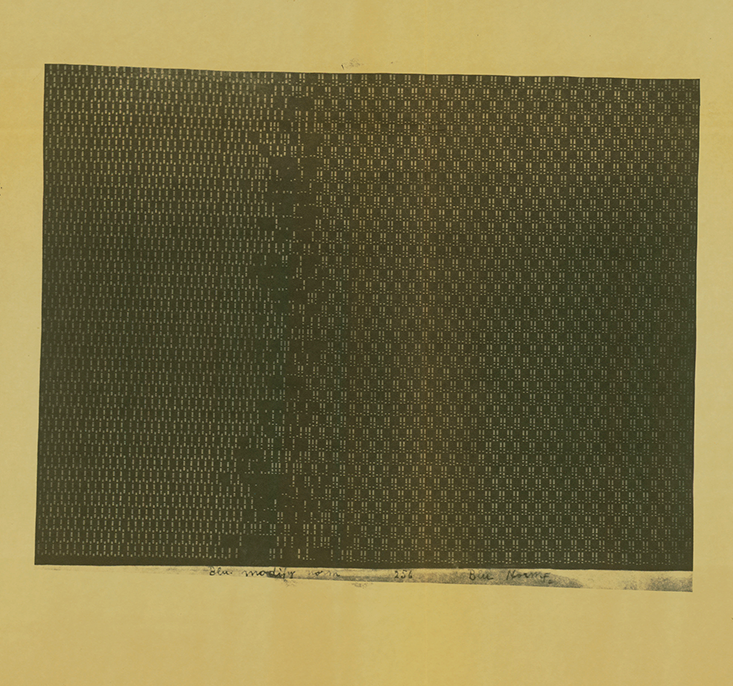
Giulia Bianchi and Tim Taylor teamed up to translate his 1954 paper “Esempi Numerici di Processi di Evoluzione” (Numerical Examples of Evolutionary Processes) from Italian to English! It is in the ALife journal (closed access): Numerical Examples of Evolutionary Processes or open access here.
Intelligence in Nature — Artificial Life, Emergence, and Computational Form
Shared by Yuvraj Mittal
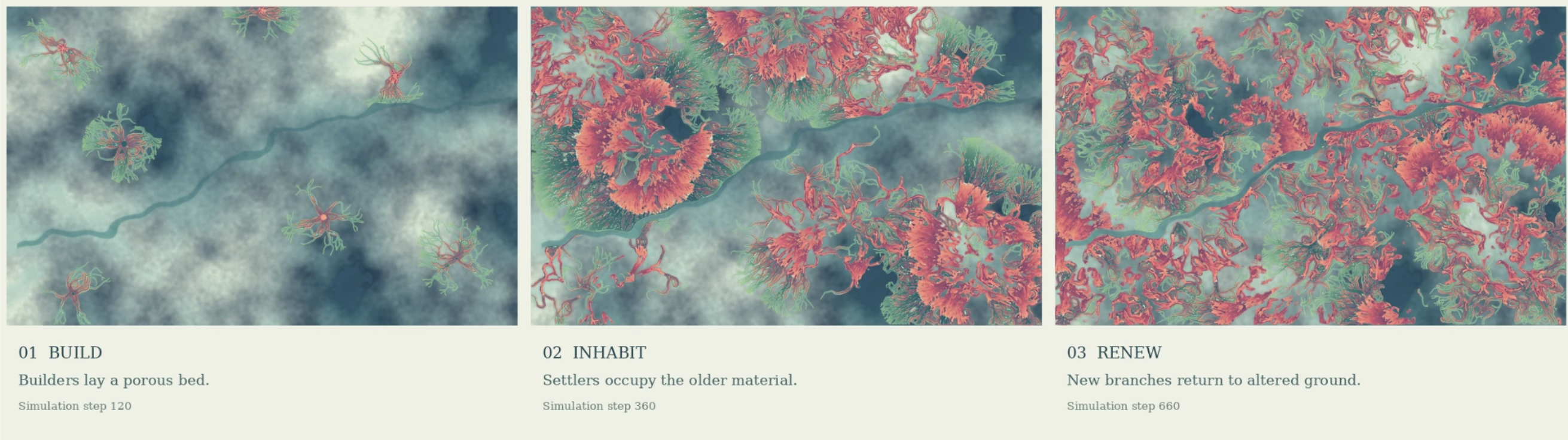
Portfolio: yuvrajmittal.com
Intelligence in Nature is a collection of four computational artworks exploring how intricate, organic forms emerge from local interactions in artificial-life systems.
Through simulations inspired by fungal networks, cellular growth, and other living processes, the collection explores emergence as both a computational phenomenon and an artistic medium. Rather than depicting biological forms directly, the works allow structures and patterns to develop through simulated dynamics.
Each piece is presented as a moving artwork, accompanied by an explanation of its underlying process, source code, and reproduction instructions.
The collection includes Anastomosis, Interstices, Pelagic, and Inhabited Ground
3D Game of Life
summary by Claus
Last month Imy was looking into 3D versions of the game of life. Out of several projects, Cubic Life looked the best.
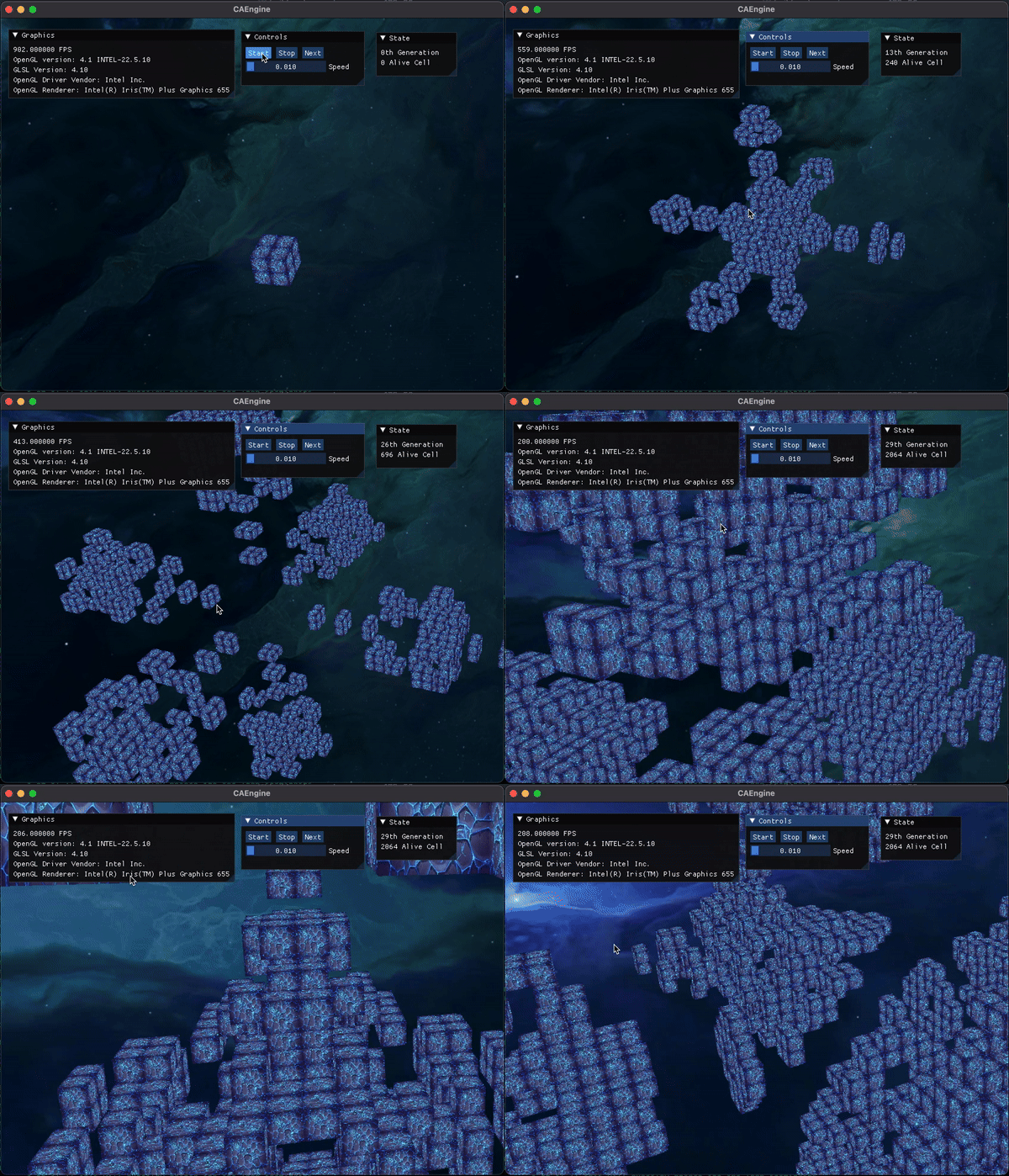
(If the animation does not show, you can see it here.)

Each cell looks at its 26 neighbors (+-1 in all 3D directions). A live cell becomes death with less than 5 or more than 6 neighbors. A dead cell becomes alive with exactly 4 neighbors.
The website does not have a lot of information on the hows and whys of these rules, but it is interesting to think how the addition of an extra dimension interacts with the celular automata rules. Personally, I'm curious about why the birth rule ends up being outside the boundaries of the death rule, unlike 2D GoL.
Do you know any interesting materials or theories about 3D GoL? Send us a message!
Blog Post: Artificial Life In Music
written by Claus
Helen Bledsoe is a musician and alife researcher, who recently wrote a nice text introduction to Artificial Life in Music in their homepage.
The blog post lists several landmark works that mix artificial art and arts, divided chronologically and by theme. The large number of citations makes this a must-check reading list for anyone interested in the theme!
(The entire blog is a great resource, and worth bookmarking and adding to your feed list).
The Cognition Project Podcast
Shared by Imy
In case you needed another podcast...
Cognitive science is pervasive in ALife, with many of the field's influential figures and ideas coming from this field. So I found it really cool to see this new podcast that traces the history of cognitive science through oral history interviews with prominent figures in the field. The creator, Tom Griffiths of Princeton University, has developed it in a way that allows it to be adapted or mapped onto undergraduate cognitive science courses, which could be really useful for incoming (or current) students, as well as anybody who is putting such a course together.
From the creator himself:
Over the last decade I have been doing oral history interviews with cognitive scientists and am releasing them in a podcast called the Cognition Project. Currently we have interviews posted with Jerome Bruner, Molly Potter, Susan Carey, Lila Gleitman, Noam Chomsky, Jean Berko Gleason, Tom Bever, Dan Slobin, Richard Atkinson, Gordon Bower, Roger Shepard, Rich Shiffrin, Elizabeth Loftus, Ewart Thomas, Phil Johnson-Laird, Donald Norman, Eleanor Rosch, and Douglas Hofstadter. The interviews so far have focused on the cognitive revolution, mathematical psychology, and the first cognitive science conferences, but we’re moving into a section on different approaches to AI and the origins of neural networks. The interviews are designed to be accessible to undergraduates so they can be assigned in classes where you cover the work of these researchers.
Apple: https://podcasts.apple.com/us/podcast/the-cognition-project/id1872765981
Spotify: https://open.spotify.com/show/7rhwBGhEQCtO9cBguazFsq
It feels like there's an opportunity to do something similar for ALife. Hmm...
Book: Collective Intelligence by Agnieszka Kurant
Shared by Lana
A new book published by MIT press, blurb below.
Conceptual artist Agnieszka Kurant's work alongside newly commissioned texts by renowned thinkers across science, philosophy, technology, anthropology, and economics.
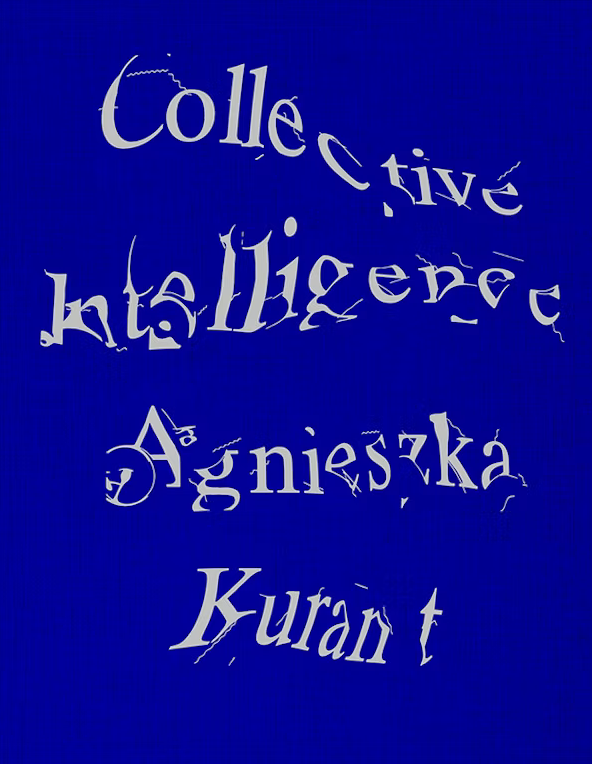
Collective Intelligence is an innovative monograph that documents the last ten years of Polish-born conceptual artist Agnieszka Kurant's interdisciplinary practice. It includes newly commissioned texts by renowned thinkers in science, philosophy, art, technology, anthropology, and economics.
Kurant's experimental work investigates collective and nonhuman intelligences and their impact on transformations of the human, the future of labor and creativity, and the exploitations within digital capitalism. Questioning the ideology of individualism, Kurant proposes that we rethink human and more-than-human worlds from a perspective of plural subjectivity, and, through this fundamental shift in perspective, posits the possibility of alternative political imaginaries. Her work probes the replacement of individual authorship with collective intelligence—a phenomenon observed in slime molds, termite colonies, social movements, cities, the internet, and inside our brains.
In her collaborative practice, the artist investigates artificial intelligence, emergence, cybernetics, automation, artificial life, mining industries, and energy circuits to explore our collective evolution and the shifting status of objects in relation to agency, value, circulation, and redistribution. Through crowdsourcing the production of her artworks to thousands of humans and nonhumans, Kurant creates unstable, hybrid forms that constantly evolve. Her works, oscillating between biological, digital, and geological, embody the crumbling distinctions between what is natural and artificial, real and synthetic, and life and nonlife.
Dispersed throughout the book, the Phenomena section adopts a quasi-encyclopedic format to highlight and expand on Kurant's research on collective intelligence.
Contributors:
Monika Bakke, Philip Ball, Shumon Basar, Franco “Bifo” Berardi, Nicolas Bourriaud, Rosi Braidotti, Carolyn Christov-Bakargiev, Kate Crawford, Diedrich Diederichsen, Graham Harman, Stefan Helmreich, Caroline A. Jones, Nora Khan, Esther Leslie, Jussi Parikka, Matteo Pasquinelli, Tobias Rees, Jessica Riskin Elvia Wilk
Job openings
Santa Fe Institute - Postdoctoral Research Fellowship: Network Thermodynamics of Distributed Computation
The Santa Fe Institute — a private, not-for-profit research and education organization — has an opening for a two-year full-time postdoctoral fellowship. They are seeking a highly motivated scholar with expertise in physics (or in special cases in computer science), who has a desire to apply their expertise to understand the thermodynamic cost of distributed computation, from digital circuits and neural networks to human brains.
This position is based in-person in Santa Fe, NM. The desired start date is no later than June 1, 2027. Interested people should check the job posting at the Santa Fe Institute's webpage
Seminars
Teaching in Interdisciplinary Settings: The hows, whens, and whys? (October 29th)
The ALife-Edu group is hosting a virtual talk titled Teaching in Interdisciplinary Settings: The hows, whens, and whys? by Amanda Jean Bowerman on Oct 29th at 9AM EDT. The talk will be at this Zoom link and the abstract is below. We'll be recording and sharing that for those who can't make the time.
Interdisciplinarity is becoming a fundamental element of both academia and industry, as fields like data science, cognitive science, and artificial life are becoming more prevalent. These types of fields are appealing to undergraduate students by offering the ability to integrate knowledge across various domains of interest. However, teaching in interdisciplinary spaces has proven to be challenging, as undergraduate students are still developing disciplinary knowledge coupled with the varying meanings for terminology across disciplines. There has been some recent research into investigating how to facilitate conversations in interdisciplinary settings in addition to developing a toolkit and resources for designing interdisciplinary courses. Flipped classrooms have been instrumental in the integration of interdisciplinarity, providing students the ability to interact through discussion and promoting active learning. In this talk, I will discuss how to handle some of the challenges of teaching in an interdisciplinary setting, drawing insights from my own experiences teaching in interdisciplinary intro-level data science courses while also providing resources and suggestions for implementing interdisciplinary domains in a flipped classroom setting.
NEW CFP and Deadlines
“Life As It Could Be: Interdisciplinary Perspectives on Artificial Life” (October 23rd)
** Deadline: October 23rd 2026 **
Date: 7–8 December 2026 Location: Aula Symbiosis, Bioscience Center, Belgium
This mini-symposium will provide a forum for discussion of A-Life’s objectives, overarching theoretical frameworks, main achievements and shortcomings, and prospects for the coming decades of scientific inquiry into what life is and could be—in silicon, in laboratories, and perhaps beyond Earth.
We welcome contributions from theoretical and empirical researchers—philosophers and scientists alike—interested in fostering interdisciplinary dialogues on the past, present and future of A-Life as a scientific field.
We invite submissions of abstracts (max. 500 words) for presentations. Abstracts must include affiliation and contact information. Please send the abstracts to Alejandro Fábregas-Tejeda via email (alejandro.fabregastejeda@kuleuven.be).
Still active CFP and Deadlines
evo* (EvoStar) 2027 (November 1st)
- Conference Webpage
- Deadline: November 1, 2026
- Venue: Mainz, Germany
- Conference: 31 March to 2 April 2027
EvoStar is a joint event of several European Conferences on topics related to Evolutionary Computation. This year, a new sub-conference has been added: evoLearn - The 1st International Conference on Evolutionary Computation and Learning (evoLearn 2027)
AROB 2027 (October 28th)
- 32nd International Symposium on Artificial Life and Robotics
- Submission Deadline: 28 October, 2026, 24:00 UTC
- Conference Date: 19-22 January, 2027
- Venue: B-Con PLAZA, Beppu, Japan
IEEE CEC 2027 (Feb 28th)
- IEEE Congress on Evolutionary Computation
- Submission Deadline: 28 February 2027
- Conference Date: July 25-28
- Venue: Edinburgh, Scotland
ESANN 2027 (Nov 18th)
- European Symposium on Artificial Neural Networks, Computational Intelligence and Machine Learning
- Submission Deadline: 28 November 2026
- Venue: Bruges, Belgium, and online (hybrid)
- Conference Date: · 21–23 April 2027
About the Artificial Life Newsletter
The ALife Newsletter is a bi-monthly publication that aims to bring interesting news to the Artificial Life community.
The current editors of the newsletter are:
- Lana Sinapayen
- Claus Aranha
- Imy Khan
- Martha Emerson
The newsletter is sent by e-mail and can also be accessed by RSS. You can subscribe here or follow the RSS feed here.
If you have any suggestions for future content, or would like to help us edit the newsletter, you can leave us a message in the feedback form. We specially appreciate messages from Master's and PhD students who want to talk about their recent work. Send us a line!