Alife News
The Artificial Life Community Newsletter
A word from the team
As the threat of summer heat looms upon us in the Northern hemisphere, and the respite of winter in the Southern hemisphere, the ALife Newsletter team wishes you the best of thermal insulation! It is also the season of conferences, so get your slides ready. In this edition, we bring you an expansive multiverse, tiny life(like)forms, and a call for reflection/action on climate change.
Subscribe to the ALife Newsletter! Alternatively, you can register our RSS feed to read the newsletter from the comfort of your favorite RSS reader! (Claus recommends Liferea)
Let us know what you liked, what you didn't like, what you would like to see more or less! If you have any suggestions for future content, or would like to help us edit the newsletter, you can leave us a message in the contribution form. You can find past editions of the newletter here.
Lana, Imy, Martha, and Claus
Video: The Conway Multiverse by Cary Huang
Writeup: Lana
This video by Cary Huang explores the space of automaton rules adjacent to the Game of Life rules by J. Conway. It starts with an excellent primer on 2D binary automata, and continues with a discussion of what "stability" and "complexity" mean in the context of 2D automata. The visualizations are gorgeous and make all of the concepts easy to understand. One caveat: Huang uses "chaotic" in several ways that do not correspond to classic definitions in complex systems. Make sure to check out his channel, it is full of fun videos!
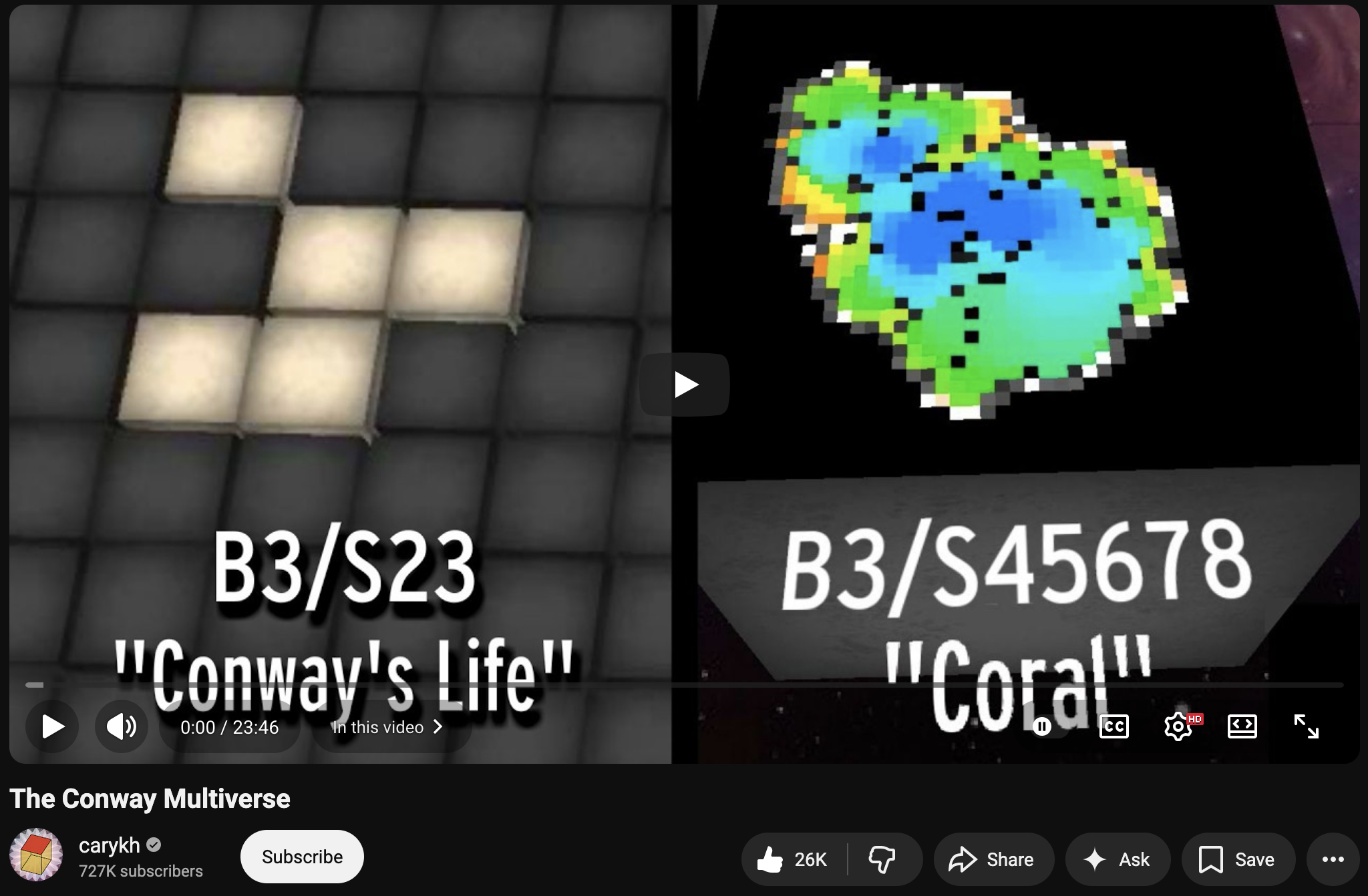
https://youtu.be/QK_KZv-YyOc?si=lu5JVxpXhLVzwnjA
News: Synthetic Life from SpudCells
by Martha
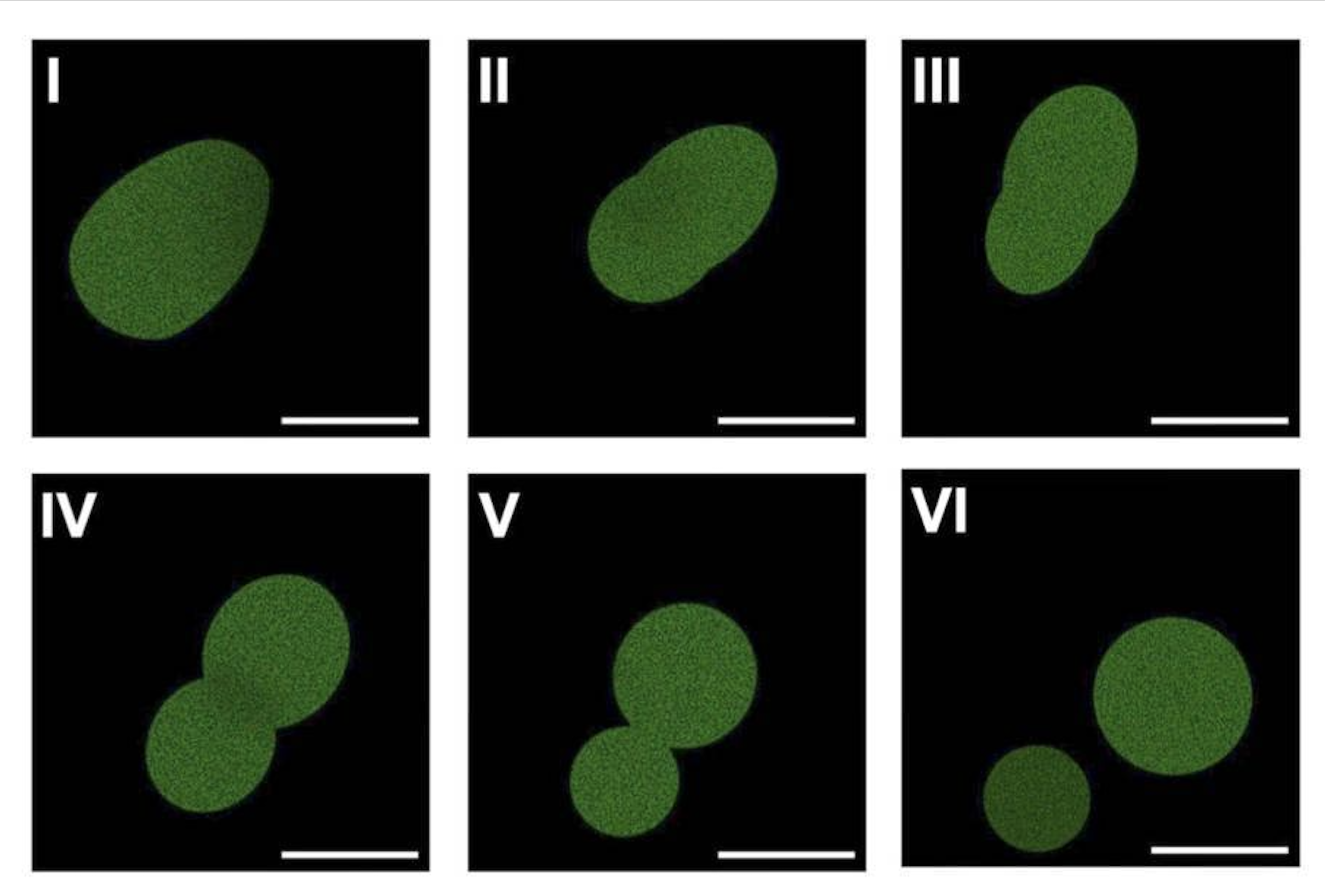
In the quest for synthetic life, scientists often rely on simple existing lifeforms as a scaffold. Kate Adamala's team at the University of Minnesota had a different idea: her team's SpudCells are built from scratch. The simple cells have a fatty outer layer with water in the middle, and "live" in a bath that provides the chemicals the SpudCells need to grow and divide.
So here we have synthetic cells behaving somewhat like actual living cells. And what's really exciting here are the possibilities: how can these cells be used to model evolution? what are the minimum requirements for life? what would it take to make a synthetic cell self-reliant, and what would that tell us?
You can read more in the preprint, here
https://www.theguardian.com/science/2026/jul/01/synthetic-life-lab-made-dna-spudcells-scientists
The Climate Cost of LLMs
by Claus
Recently, the role of LLMs in research (both as research topics and tools) has become a big topic of discussion, specially in ALIFE.
Among the discussion of whether they are useful or not, and how they relate with ALIFE-y topics such as agency and open-endedness, it is essential not to lose sight of their externalities: In other words, the ethical costs that this technology imposes on us and others.
Recently, Ketan Joshi, a climate analyst and advocate, wrote a deep analysis of Google's yearly Climate report which is well worth reading. This analysis makes clear the rapidly growing environmental costs of generative AI.
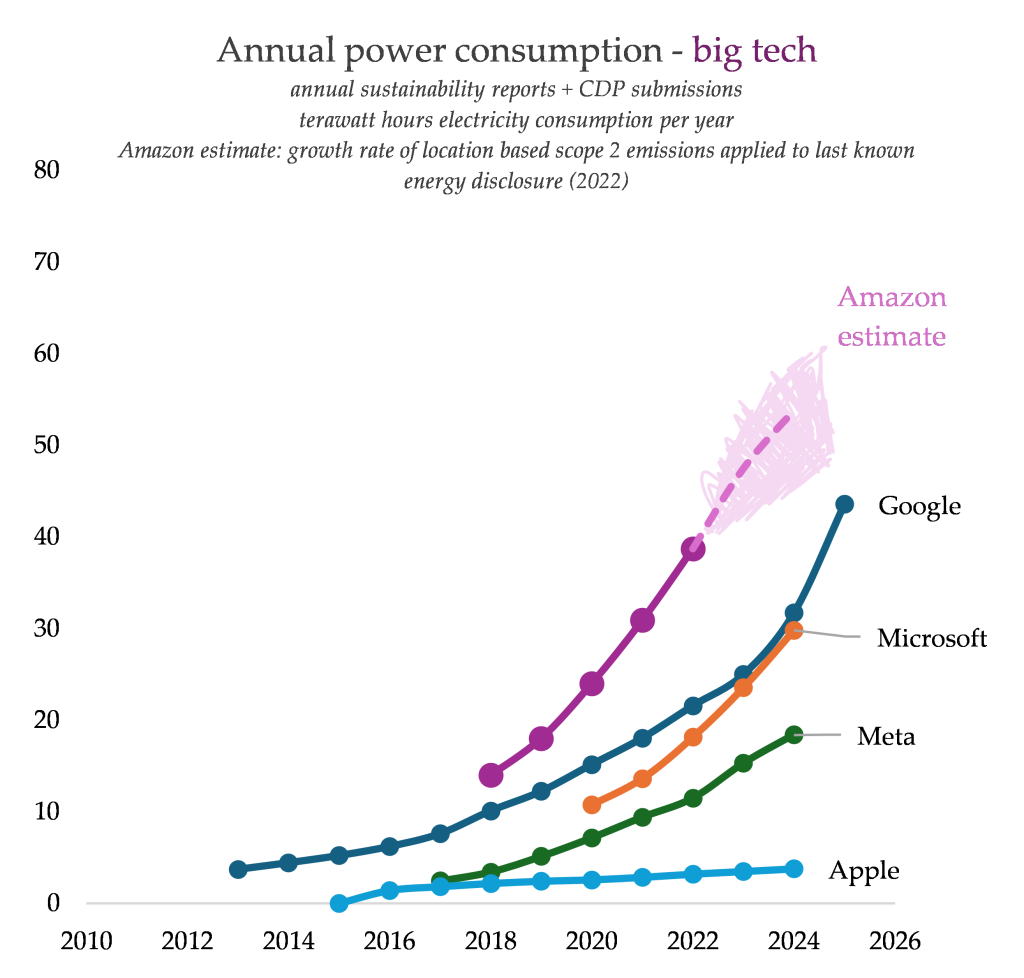
We as ALIFE practitioners should make sure that we take this cost into account when making decisions such as when and if to use this tools, and whether to allow them in our conferences and journals.
Call: ERA Lightning Talks at ALIFE 2026
Are you an early career researcher or ALife hobbyist with a cool project, research idea, interesting demo, early results, or something else you'd like to share with the community? The Emerging Researchers in Artificial Life would love to hear from you, and they are welcoming lightning talk contributions as part of the ERA workshop at ALIFE 2026.
Your work does not have to be finished or polished. Lightning talks are all about exchanging ideas, getting feedback, and starting new conversations. Lightning talk slots are ten minutes long with five minutes for Q\&A.
If you are interested in giving a talk, click here to register.
Paper: Substrate-Coupled Artificial Life in Silicon
Daniel Grachov, from Metal Dreams, introduces the preprint: The Critical Substrate: A Theoretical Foundation for Substrate-Coupled Artificial Life in Silicon.
The paper proposes substrate-coupled artificial life as a research programme: not the simulation of life on silicon, but the experimental investigation of life-like organisation as a property of silicon substrates under controlled non-equilibrium operation. It argues that conventional CMOS systems, including MOSFET 1/f noise, cache-latency gradients, and DRAM dynamics, may provide structural preconditions relevant to emergent life-like organisation.
CFP and Deadlines
IEEE SSCI-CIS 2027 (August 10th)
- IEEE Symposium on Computational Intelligence in ALIFE and Cooperative Intelligent Systems
- Submission Deadline: 10 August, 2026
- Conference Date: 14-17 Feb, 2027
- Venue: Gold Coast, Queensland, Australia
ERA Workshop Lightning Talks at ALIFE 2026
EMO 2027 Submission (September 28th)
- International Conference on Evolutionary Multi-Criterion Optimization
- Submission Deadline: 28 September, 2026, AOE
- Conference Date: 5-8 April, 2027
- Venue: University of Exeter, Exeter, United Kingdom
Conference on Complex Systems (CCS 2026)
CCS 2026 Warm-Up
October 9-10th, 2026
A two-day informal event for PhD students and early-stage scientists. You will have the opportunity to attend talks by prominent researchers, learn about the scientific and life experience of young and senior colleagues, and – last but not least – have fun and socialise!
Twelfth International Conference on Guided Self-Organization (GSO-2026)
October 14-15 (during CCS 2026)
- Deadline for abstracts: 22 July 2026
- Submission form
- Submission template
- Registration
GSO "aims to regulate self-organization for specific purposes, so that a dynamical system may reach specific attractors or outcomes. The regulation constrains a self-organizing process within a complex system by restricting local interactions between the system components, rather than following an explicit control mechanism or a global design blueprint."
AROB 2026 Submission (October 28th):
- 32nd International Symposium on Artificial Life and Robotics
- Submission Deadline: 28 October, 2026, 24:00 UTC
- Conference Date: 19-22 January, 2027
- Venue: B-Con PLAZA, Beppu, Japan
IEEE CEC 2027 (Feb 28th)
- IEEE Congress on Evolutionary Computation
- Submission Deadline: 28 February
- Conference Date: July 25-28
- Venue: Edinburgh, Scotland
About the Artificial Life Newsletter
The ALife Newsletter is a bi-monthly publication that aims to bring interesting news to the Artificial Life community.
The current editors of the newsletter are:
- Lana Sinapayen
- Claus Aranha
- Imy Khan
- Martha Emerson
The newsletter is sent by e-mail and can also be accessed by RSS. You can subscribe here or follow the RSS feed here.
If you have any suggestions for future content, or would like to help us edit the newsletter, you can leave us a message in the feedback form. We specially appreciate messages from Master's and PhD students who want to talk about their recent work. Send us a line!